Blog
Economic Security: Recapping the 2025 Legislative Session
- Economic Security
- Family Economic Security
By
Emily Moore
For an overview of House and Senate proposed budgets, visit our blog from February 6.
For a spreadsheet of 2025 investments in Economic Security budget priorities across each step of the budget process, click here.
Every parent wants to provide a better life for their children, but it is hard to be a parent right now. Many Virginia families are still suffering from the economic impacts of the pandemic and rising cost of living, and many are struggling to make ends meet.
According to the most recent Census Pulse Survey:
- One-third (33.3%) of families with children reported sometimes or often not having enough to eat.
- Two-thirds (65.7%) of families with children reported having at least a little difficulty paying for usual household expenses in the last week.
The hardships and stressors associated with poverty can be particularly damaging to a child’s development – especially when they don’t have access to nutritious foods to support their growing bodies and brains. We must do more to ensure that working Virginians receive a consistent, fair wage for a day’s work so that they don’t have to wonder if they will be able to provide for their children.
Making Young People the Agenda in Wage, Tax, and Nutrition Policy During the 2025 Legislative Session
Virginia lawmakers heard the demands from families across the commonwealth who called on them to make bold choices to invest in and prioritize economic security and tax fairness with Virginia’s budget surplus. The bipartisan budget passed by the General Assembly prioritized families with needed tax relief and solidified a foundation to lift them from the margins and remove barriers to earning a living wage. Unfortunately, the governor’s veto power once again proved to be the biggest barrier to enacting family-focused policies, like Paid Family and Medical Leave and increasing the minimum wage.
We are celebrating several legislative policy efforts to address food insecurity that passed the General Assembly this session. However, we are extremely disappointed to see the gutting of funding and policies that center young people and families in policymaking. The final budget misses the mark on making bold, family-focused investments and does not go nearly far enough to lessen the burdens of hunger on Virginia’s families.
2025 Legislative Outcomes
The following bills passed the General Assembly and were signed into law by the governor. These bills will go into effect on July 1, 2025:
- HB2240 (Del. Cousins)/SB1016 (Sen. Roem): Hunger-Free Campus Food Pantry Grant Program to address food insecurity on college and university campuses by providing funding to institutions of higher education to support on-campus efforts and initiatives to eliminate student food insecurity.
- HJ447 (Del. Anthony): Virginia Commission to End Hunger to establish a statewide food desert mapping tool.
- SB1018 (Sen. Roem): Virginia Dept. of Social Services (VDSS) to provide resources to public institutions of higher education on SNAP. Colleges and universities will distribute these resources to all students at the beginning of the fall semester of each school year.
- SB1019 (Sen. Roem): Virginia Dept. of Health to provide information, resources, and education to food banks regarding helping individuals complete a Women, Infants, and Children (WIC) application.
- SB1020 (Sen. Roem): VDSS to report on the implementation of the SNAP Restaurant Meals Program – report due December 1, 2025.
The following bills passed the General Assembly, but were amended and/or vetoed by the governor:
- HB1723 (Del. Price): Dept. of Social Services workgroup to evaluate methods to improve access to and maximize participation in food assistance programs
- Governor Youngkin recommended amendments to this bill that would have (i) removed all recommended stakeholders and (ii) removed parameters for the scope of the workgroup’s work.
- The General Assembly rejected the governor’s amendments, so the governor has 30 days to either veto the bill, sign the bill as enrolled, or take no action and the bill will still become law.
- HB2531 (Del. Sewell): State-Administered Paid Family and Medical Leave Program
- Governor Youngkin vetoed this legislation, citing a concern about Virginia’s ability to “maintain competitive job growth, attract corporate relocation, secure capital investment, and retain population” if this policy were to be enacted.
- HB1928 (Del. Ward): Increase Virginia’s Minimum Wage to $15 by 2027
- Governor Youngkin vetoed this legislation, citing that the “free market for salaries and wages works.”
- HB1921 (Del. Ward): Paid Sick Leave
- Governor Youngkin vetoed this legislation, citing that paid sick time for employees would “increase the cost of doing business in the commonwealth and adversely impact our business climate.”
Four of Voices’ priority bills did not pass the General Assembly during session:
- HB2180 (Del. Tran)/SB1378 (Sen. Aird): State-Level Child Tax Credit
- Both bills died in the money committees – House Appropriations and Senate Finance & Appropriations, respectively.
- HB1717 (Del. Price)/SB810 (Sen. Rouse): Increase the refundable Earned Income Tax Credit to 20% of the federal credit and extend the sunset date
- While the legislation did not pass, the increase to the EITC was included in the final budget (see below).
- HB1958 (Del. Bennett-Parker)/SB1003 (Sen. Roem): School Breakfast for All
- Both bills passed their policy committees – House Education and Senate Education and Health – but died in their respective money committees.
- SB1122 (Sen. Boysko): Paid Family and Medical Leave
- SB1122 passed the Senate and reported from House Appropriations, but unfortunately the bill was on the House floor for final passage the day that any bill generating revenue must pass both chambers with majority support and it did not receive enough votes.
2025 Budget Outcomes
Tax Fairness
- One-Time Non-Refundable Tax Rebate: Virginia tax filers will receive a one-time tax rebate in fall 2025 of $200 for single filers or $400 for married people filing a joint return.
Family Income and Work Supports
Food and Nutrition Access
- Hunger-Free Campus Food Pantry Grant Program: $500,000 GF for the State Council of Higher Education for Virginia (SCHEV) to administer grant funding to public and private colleges and universities to create initiatives on campus to address student food insecurity.
- Technical Update to School Breakfast Incentive Fund
- This is not to be interpreted as a “new” investment – this fixes the omission in the governor’s introduced budget of funding for school breakfast reimbursement increases that passed in 2024 session, which increased the reimbursement from $0.22 to $0.28 per breakfast.
The following economic security initiatives were not included in the final budget:
- Virginia Fresh Match Program: Would have provided $1 million to the Virginia Fresh Match nutrition incentive program to support offering affordable, locally sourced produce to SNAP recipients.
- Child Tax Credit: Would have established a one-time state-level refundable child tax credit of $300 credit per child aged 12 or younger in households making up to $100,000 adjusted gross income.
What’s Next?
In partnership with the Virginia Food Access Coalition and the Healthy School Meals for All Coalition, Voices is analyzing the impacts of proposed federal funding cuts to SNAP, school meals, and other local food and agriculture programs that serve children and families.
We are working to ensure our state and federal lawmakers understand the important intersections between Medicaid, SNAP, and school meals, and how cuts to any of these programs will have devastating impacts on families across the commonwealth and would undoubtedly increase hunger.
How can we respond at the state-level?
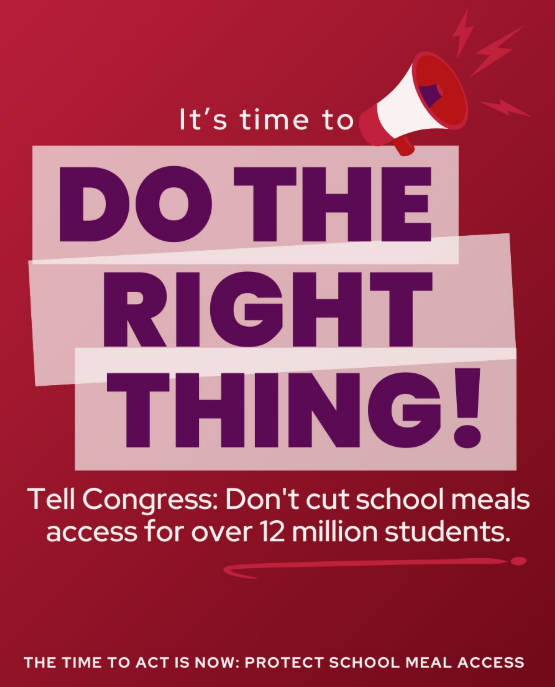
We encourage everyone to reach out to their Congressional Representatives using the action alert below to highlight the importance of protecting funding for SNAP and school meals. Proposed cuts would worsen childhood hunger, hurt struggling families, and create unnecessary burdens for schools and community members trying to access support.
We also have the ability to center families and young people in the decision-making process in state policymaking, as the House and Senate have established committees to analyze potential impacts that reduced federal funding has on Virginia’s budget. Advocates can connect with the members of these committees and share the impact that SNAP, school meals, and Virginia’s food banks have on our lives and in our communities.
Now is the time for us to share our stories about how important SNAP and school meals are for us and for communities. Join us in telling elected officials at the federal level to prioritize Virginia’s children and families in funding decisions.
Take Action Now to Protect School Meals and SNAP!
Click the image above to take action today!
Economic Security
Family Economic Security
State Advocacy
February 6, 2025
Economic Security
Family Economic Security
Health Equity
March 6, 2025
Healthy School Meals for All
March 20, 2025