Family Economic Security
Health Equity
State Advocacy
“Breaking the Health-Poverty Cycle: The Urgent Need for Paid Family and Medical Leave in Virginia” Policy Brief
August 15, 2024
This session, lawmakers in Virginia have the opportunity to enact one of the most impactful policies for the well-being of children and families—paid family and medical leave (PFML). For those unfamiliar, state PFML programs provide working parents with the time and financial security needed to recover from childbirth, bond with a new child, or care for their families.
Research shows that PFML is one of the most effective policies a state can implement to promote parental employment, improve parent-child relationships, and boost parent and child health. Statewide PFML programs are self-sustaining and funded through small payroll contributions from workers, employers, or both.
Fourteen states have adopted a statewide PFML program, and Virginia has the opportunity to become the 15th. Legislators in Virginia have led the way on PFML for the last two legislative sessions, passing bills through both chambers to advance PFML in the state—which were later vetoed by former Governor Youngkin.
This legislative session, Senator Jennifer Boysko and Delegate Briana Sewell introduced companion bills SB 2 and HB 1207 to create a statewide PFML program in Virginia. If passed and signed by Governor Spanberger, the new PFML law would:
The Prenatal-to-3 Policy Impact Center at Vanderbilt University has worked alongside lawmakers and partners in Virginia to better understand the impact of a PFML policy in the state. Our analysis indicates that a PFML program would have positive effects on child and family wellbeing—generating approximately $224 million in annual net benefits to Virginia families, businesses, and the state.
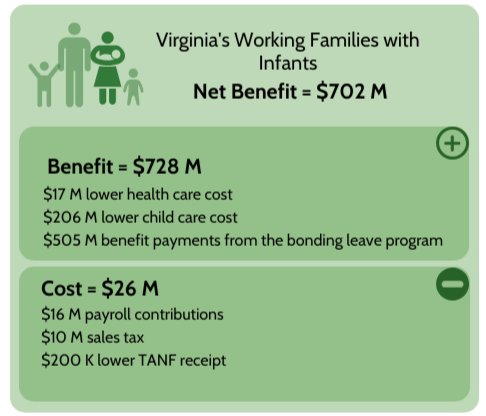
For families, the program would promote family well-being by providing needed bonding time and would also lead to significant health and economic benefits for working families with infants. In the first year, families who take PFML incur lower health care and child care costs. Over the longer term, these families experience increased household income, increased attendance at postpartum doctor’s visits, and decreased infant hospitalization and maternal distress, among other benefits. By contributing to the PFML program through small payroll contributions, employees participating in PFML would receive double—or more—return on their investment.
For businesses, the program would have measurable impacts on the workforce. According to our estimates, the program would lead to an estimated 8,500 more mothers still working at their pre-birth employer on their child’s first birthday. Retaining employees leads to substantial savings for businesses.
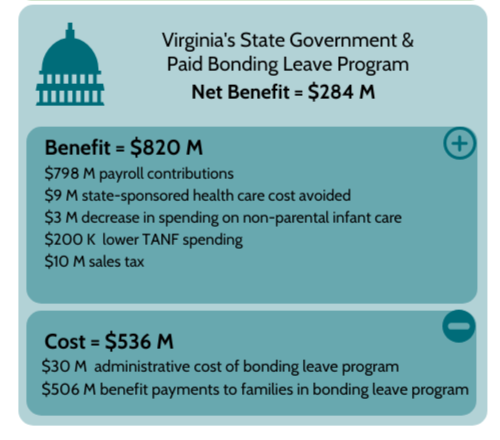
For the state, the program would be budget-neutral because it is funded through small payroll contributions from employers and employees. Our analysis shows that the benefits of the program outweigh the costs by a ratio of 8.4 to 1, with benefits to the state including increased sales tax revenue collected and state-sponsored health care costs avoided as a result of the program.
Overall, our analysis, which is based on a substantial body of rigorous research, suggests that the enactment and implementation of a statewide PFML program in Virginia could lead to maternal and infant lives saved, improved health and development over the lifespan, and economic benefits for families with young children, with no ongoing cost to the state.
For more information on paid family and medical leave across states, visit the 2025 Prenatal-to-3 State Policy Roadmap.

August 15, 2024