Child Welfare
Family Economic Security
Rethinking Child Abuse Prevention in Virginia
April 29, 2026
The SPM helps leaders understand how choices affect children’s daily lives and long-term outcomes. Continued federal data collection is vital for tracking progress and targeting solutions.
2025 KIDS COUNT SPM Report
In Virginia and across the country, children are suffering due to the multifaceted impacts of poverty. A new Annie E. Casey KIDS COUNT report highlights how childhood poverty is a policy choice and how investments in supportive programs can reduce harm to children and families.
To better capture child poverty and illustrate the impacts of economic investments, like the earned income tax credit (EITC), child tax credit (CTC), supplemental nutrition assistance program (SNAP), etc., the report uses the supplemental poverty measure (SPM).
SPM differs from other measures of poverty, which often narrowly rely on family income, because the measure considers changes in benefits received and additional expenses over time. For example, if a family receives free school lunch and breakfast for one year, they can take those food savings and spend money on other necessities. Specifically, in the previous school year, the average maximum out-of-pocket cost for school breakfast and lunch was $876 in VA, which equals about a months’ worth of groceries for two people or two months’ worth of utilities.
That same year, this family may be paying additional expenses in childcare, which detracts from their income. For example, in 2024, the average family in VA paid $18,759 for infant care (0-15 month olds), which is roughly twelve weeks of wages for the average working Virginian, according to a September 2025 wage report. SPM accounts for all these changes in each year to more accurately measure poverty over time.
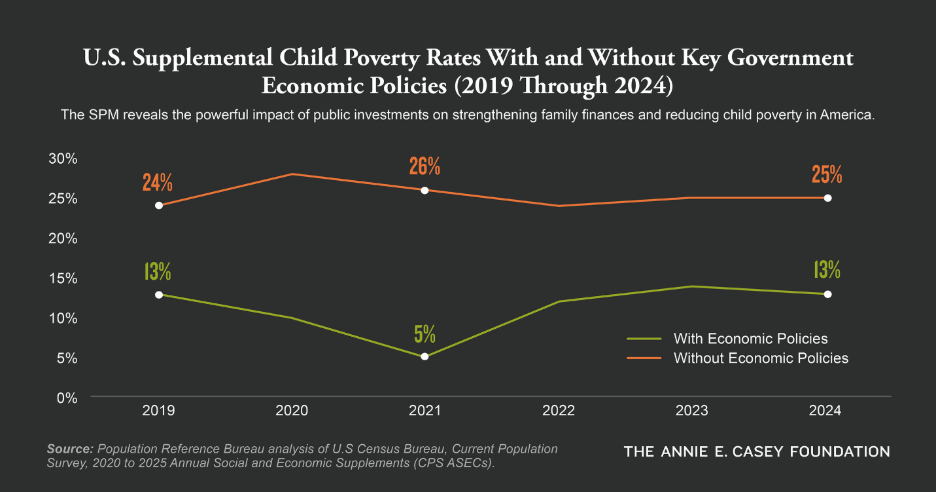
Using this more holistic view of poverty, the report highlights how childhood poverty rates reached an all-time low of 5% nationally in 2021, following the distribution of federal pandemic relief funds. In 2024, SPM rates rose nationally to 13%, indicating a major backslide. Increases in poverty were the starkest for Black and Hispanic children. For example, in 2024, roughly one in four (23%) Black children and one in five (21%) Hispanic children nationally lived in poverty according to the SPM. Poverty rates for Black and Hispanic children, from 2021 to 2024 increased by 15 and 13 percentage-points, respectively. In contrast, seven percent of White, non-Hispanic children and ten percent of Asian and Pacific Islander children lived in poverty in 2024. For both groups, this represents a four percentage-point increase from 2021.
Virginia’s Supplemental Child Poverty Rate was 12% in 2022-2024, which is in the bottom third quartile of all fifty states and the District of Columbia. This child poverty rate would increase to 20% without supportive services.
Similar to national trends, Virginia experienced increases in child poverty during this time. Specifically, from the 2021-2023 to 2022-2024 time-period, the number of Virginia’s children (0-17) living in poverty according to the supplemental poverty measure increased from 207,000 to 230,000 children. This increase of 23,000 children living in poverty (more than the capacity of the Capitol One Arena) could have been even worse without the support of various government investments.
The major support programs that the SPM assesses in Virginia include refundable tax credits, EITC, CTC, Social Security, Supplemental Security Income (SSI), SNAP, and housing subsidies. All these programs lift children out of poverty. In Virginia from 2022-2024, these programs kept 148,000 children out of poverty. Programs like refundable tax credits had the largest impact on child poverty reduction (lifting 55,000 children out of poverty), followed by Social Security (lifting 41,000 children out of poverty), and EITC (lifting 31,000 children out of poverty).
We Almost Ended Childhood Poverty Once and Can Do It Again
These documented increases in child poverty come at a time when the federal government is rolling back supportive services, like SNAP. With that, not all hope is lost on a state-level where supportive programs like refundable tax credits, EITC, CTC, etc. can be bolstered to reverse the disheartening trend of child poverty continuing to increase. In 2026, likely the best path to reverse this trend is through state policy reforms, which Voices will continue to advocate for in the upcoming legislative session.
Subscribe to Voices from the Capitol to stay up to date on the policies impacting young people across the commonwealth here:


April 7, 2026

March 12, 2026
February 20, 2026