Children's Mental Health
Mental Health
Policy Agenda
A Look At Youth Mental Health in the House and Senate Budgets
February 7, 2025
The Current State of Youth Mental Health
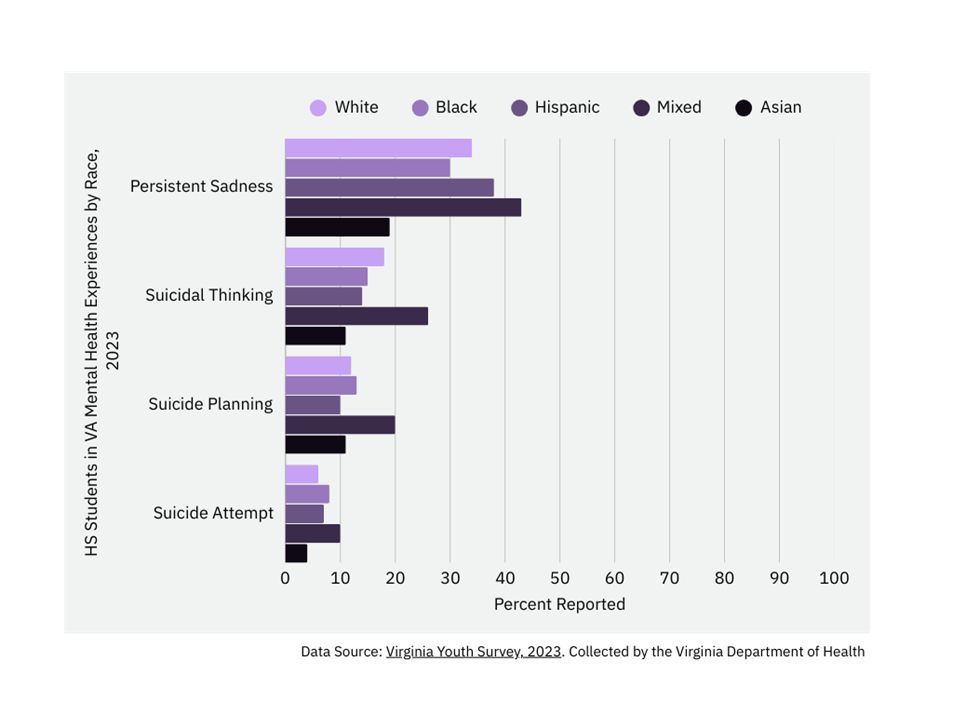
Five years from the height of the COVID-19 pandemic, we are still grappling with the impact mass isolation, record loss of lives, and heightened social unease have had on our young people’s mental health and well-being. In 2021, the U.S. Surgeon General declared youth mental health a national emergency and released a public statement naming youth mental health as an “urgent public health issue.” While it has been unclear what long-term effects the pandemic will have on young people’s mental health, today youth in Virginia continue to express feeling unwell, anxious and depressed. In 2023, 33% of all high school students in Virginia reported experiencing persistent sadness and 18% of all middle school students reported their mental health was not good “most of the time” or “always.” (Virginia Youth Survey, 2023). If we break down the data, girls in both high school and middle school experience disproportionally higher rates of persistent sadness (46.6% and 26.5% respectively) than boys in high school and middle school (20.9% and 10.9% respectively). Additionally, Black, Mixed race and Hispanic students across both gender identities and age group, reported experiencing disproportionally higher rates of persistent sadness and suicidal behaviors. Lastly, when we hear from high school students who identify as LGBTQ+, they reported significantly higher rates[GU2] of persistent sadness (64%) suicidal thinking (34%) suicidal planning (27%) and suicide attempts (14%) than their heterosexual counterparts (26%, 12%, 10%, and 6% respectively).
Making Young People the Agenda in the 2025 General Assembly Session
Approximately 22% of Virginia’s population are young people ages 0-17, however currently, only 6% of Virginia’s Mental Health budget is allocated specifically to youth mental health services or programming.
Making young people’s mental health the agenda means ensuring young people are invested in and prioritized in our mental health system.
Only allocating 6% of the mental health budget to young people which includes the Department of Behavioral Health and Developmental Services (DBHDS), Grants to Localities (GTL) and Mental Health Treatment Facilities (MHTF) budgets is unacceptable as we continue to navigate the youth mental health crisis and general dis-ease and more recently, as we counter attacks to critical federal programs that make services more accessible for our young people and their families.
For the 2025 General Assembly Session, we made Young People and Youth Mental Health the Agenda by prioritizing a variety of school-based mental health initiatives meant to expand access to care, strengthen community connections, and alleviate the burden on school professionals and staff overwhelmed by the youth mental health crisis.
While we address youth mental health challenges, illnesses, and crises through improving access to services and expanding the crisis continuum, we must also support young people where they learn and play through community-based and school-based preventative strategies and programs that build resilience, destigmatizes mental health, and teaches social-emotional skills.
Concurrently, we must continue working to dismantle the root causes of mental health challenges and mental illness by supporting families holistically and addressing the social determinants of mental health such as economic insecurity and community violence.
Read more about our Family Economic Security priorities and work ahead here.
School-based mental health supports meet students where they are – the place they spend most of their time – and provides a framework for support that extends beyond the classroom. Voices for Virginia’s Children along with our partners in the Fund Our Schools Coalition have advocated for continued support of our school counselors and other school mental health professionals to be able to do the jobs they were hired to do and to increase their reach by strengthening the state staffing ratios and improving student access to their services through implementation school-based telemental health and increasing utilization of Medicaid reimbursement in schools.
During the 2025 General Assembly, our mental health portfolio focused on rededicating funding to the school-based mental health integration pilot/program, expanding telehealth services and infrastructure in K-12 schools, improving the reach of Medicaid services in K-12 schools, ensuring infant and early childhood mental health is prioritized and beginning conversations about the importance of culturally responsive mental health services for our young people.
We know that access to critical mental and behavioral health services in schools is essential to our students’ success in and out of the classroom. When we prioritize students’ mental health, it allows them to focus on their classes, form stronger and healthier relationships with their peers and teachers, prepare them for life after graduation, and live healthy, thriving lives.
Wins:
We are grateful to the General Assembly and the Governor for supporting the passage of a package of school-based mental health bills, focusing energy on our youngest citizens’ psychological and social development, and first-time investments in youth peer support services. These wins reflect the collective priorities of youth, parents, and professionals and we look forward to the continued expansion of the following initiatives and programs moving forward.
Bills:
Landscape Scan of School-Based Mental and Behavioral Health Services:
Expanding Telehealth and Teletherapy Services in Schools:
Virginia is still falling behind in improving school staffing ratios for school psychologists (43% of the national goal met) and school social workers (30.5% of the national goal met) and while we have been making progress to meet the nation’s recommended staffing ratios for school counselors at 86.8% of the goal being met, many of our school mental health professionals are still split between multiple schools and are not always able to be present on school grounds for appointments with their students. Providing telehealth and teletherapy services in schools ensures that students do not miss extensive class time by leaving school to attend scheduled appointments, supports continuity of care when barriers exist to in-person attendance, and offers health and mental health access to communities that may otherwise have barriers to quality and timely services.
Teletherapy services can be utilized across all three tiers of the multi-tiered systems of support (MTSS) to not only support students but also school staff, mental health professionals and administrators. And while we recognize that telehealth and teletherapy services are not a substitute for in-person services, it is a supplemental strategy to serve our students as we continue to navigate critical mental health workforce shortages and high mental health needs in our student populations.
Prioritizing Infant and Early Childhood Mental Health:
Infant and Early Childhood Mental Health (IECMH) is considered the foundation of healthy development across the lifespan, especially when grounded in racial, cultural, and linguistic identity. IECMH programs are rooted in cultural-responsiveness and community care and are holistic, preventative approaches to meeting the mental health needs of young people. Infancy and early childhood are times of significant resilience but also significant vulnerability. According to the CDC, between 10-16% of young children experience mental health conditions including PTSD and anxiety – compounded by social and personal factors that exacerbate Adverse Childhood Experiences (ACEs). IECMH programs and policies hold both vulnerability and resilience in balance. This time of life is critical for building capacity to form close and secure relationships, learning to tap into our full range of emotions, and developing our curiosity in exploring the world – and according to Mental Health America, these are the three characteristics of a flourishing youth.
Incentivize Mental Health First Aid in Schools:
Mental Health First Aid (MHFA) is an evidence-based, early-intervention course that teaches participants how to recognize and respond to signs and symptoms of mental health and substance use challenges and provide initial support to individuals until professional help becomes available. Current Virginia law does not require any particular standard of mental health awareness training for school staff other than directing school boards to implement policies for school staff to complete “a mental health awareness training or similar program at least once.” MHFA is a comprehensive mental health training program that covers a wide range of topics including child and adolescent development, risk factors and resiliency, self-care for the Mental Health First Aider, common mental health challenges and disorders for youth, crisis response, and socio-cultural influences on youth mental health and well-being. Incentivizing this training for school staff is imperative as it creates a standard for support and we are excited to see the first steps to achieve this, pass the General Assembly this year.
Budget:
Opportunities:
While the following bills and budget items did not pass this year, we are thrilled to be supportive of continued conversations and education around the importance of these items that would improve Medicaid reimbursement in schools and culturally responsive mental health services for students.
Bills:
Streamline Medicaid Billing Use in Schools:
In September 2023, Virginia expanded school Medicaid programs to include all covered services for all Medicaid-enrolled students in public schools this expansion came as a reversal of the “Free Care Rule” which limited Medicaid reimbursable services to those for students with IEP.
Now, any student who has Medicaid has access to receiving Medicaid reimbursable services for mental, behavioral and physical health services in schools. The challenge is that many schools are meeting barriers to reimbursements including significant administrative burdens that are impacted by lack of capacity internally and complex legal and federal policies that impact reimbursement. Legislation sought to improve the reach of services and support school staff to better utilize this program to meet student needs.
Offer Culturally Responsive and Language Appropriate Mental Health Services in Schools:
The Center for the Study of Social Policy describes culturally responsive services as those designed for a specific population and grounded in that group’s needs, values and perspectives and expanding it further to ensure that the services are provided in the language of origin of the individual seeking services. Our students deserve mental health services that are accessible, culturally responsive, language appropriate and supportive of the diverse and unique experiences they have.
Budget:
Dedicated funding to school-based mental health and continued energy building out a comprehensive school mental health system
The Road Ahead
Federal uncertainty
We are staying informed on the current federal landscape and how the rollbacks to DEI initiatives, the pervasive harmful, targeted and discriminatory language, and the attacks to federal support programs and federal agencies will impact the well-being, safety, and care of our young people and their families. Particularly in mental health, we are concerned with the impact that proposed cuts to Medicaid will have on access to and continuity of mental and behavioral healthcare. Additionally, while long-term we are working to build stronger systems of preventative care in Virginia, our current short-term focus has shifted to protecting the mental and physical health and safety of LGBTQ+ youth, children of immigrants and immigrant youth, BIPOC youth and youth with disabilities as pervasive rhetoric and executive orders target their identities and livelihood. Our youth deserve to be able to express themselves fully without fear of discrimination or concerns for their safety. Our youth deserve to be supported in all they are and all they will be and feel a sense of belonging where they live, learn and play.
Take action here to urge your members of Congress to protect Medicaid.
Do not hesitate to reach out to Cat Atkinson, cat@vakids.org to discuss any concerns or ideas to ensure our young people are safe, mentally and physically.
At the state-level
Over the last year we have built momentum to expand and improve school-based mental health services across the Commonwealth of Virginia because we know that when we prioritize students’ mental health, it allows them to focus on their classes, form stronger and healthier relationships with their peers and teachers, prepare them for life after graduation, and live healthy, thriving lives.
Bills passed this session expand access to telehealth services in schools, study the reach of school-based mental health services across the state, ensure Mental Health First Aid is the standard of mental health training for school staff, administrators and students, prioritize mental health for our youngest citizens, and increase suicide awareness and education for parents.
However, there is still significant work to be done around investing in and resourcing these programs and a necessary commitment from all stakeholders to partner, collaborate, and communicate in order to build this system out with young people’s well-being at the center. Thus – Voices’ efforts moving forward will be focused on convening, connecting, coalescing, and educating on the importance and energy around this work that is already happening on the ground and being endorsed by students and staff in the community.
Voices will be:
If any of these actions excite you and empower you to get involved, do not hesitate to reach out to Cat Atkinson, cat@vakids.org to get connected.
At Voices for Virginia’s Children, we envision a Virginia where all young people are thriving and we achieve that by ensuring accessibility to properly resourced, fully funded, culturally responsive, timely, and quality youth mental health care.

February 7, 2025
December 18, 2024
January 23, 2025