Mental Health
Recap Blog
Youth Mental Health
2026 Session Recap: Youth Mental Health
April 12, 2026

Federal action drastically shaped the health equity landscape leading up to the 2026 legislative session.
H.R.1 , one of the most destabilizing policies passed under the current federal administration, will reduce Medicaid and Supplemental Nutrition Assistance Program (SNAP) coverage, add work and volunteer requirements, and shift additional cost burdens onto states already navigating tight budget constraints. To help state lawmakers understand what this means locally, Voices created a mapping resource that outlines the projected impact across Virginia.
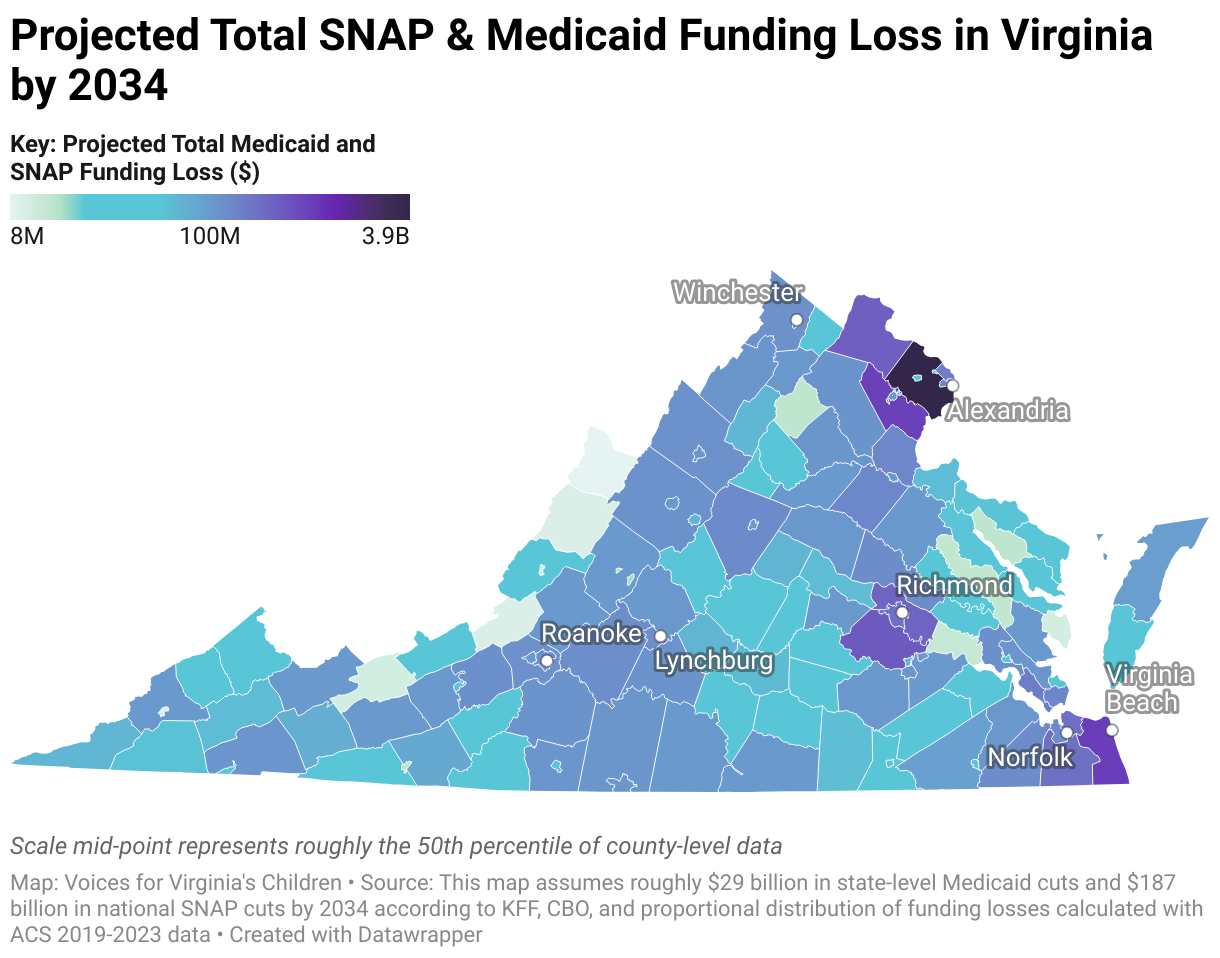
Projected total SNAP and Medicaid funding loss in Virginia by 2034.
At the same time, additional cuts to ACA enhanced premium tax credits have made accessing coverage through the marketplace more difficult. These federal decisions are deepening affordability challenges and limiting equitable access to care, particularly for families who rely on subsidized coverage to remain insured.
These changes are unfolding as Virginia’s uninsured rate continues to rise following Medicaid unwinding in April 2023. This trend is expected to continue, putting more Virginians, especially those already facing barriers, at risk of worse health outcomes and delayed care.
Across Virginia, more families are struggling to afford food, and the impact is showing up in real ways.
The data tells a clear story:
1 in 7
children in Virginia are food insecure, according to 2023 estimates.
1/3
of those children are likely ineligible for SNAP support.
50%
of families with children in Virginia’s K-12 system reported falling into debt to afford food over the past year.
Not having enough food does not just create stress. It impacts physical and mental health, from anxiety and depression to chronic conditions like high blood pressure. For children, these effects can shape long-term development.
For families already stretched thin, managing these health challenges often requires time they simply do not have.
In these moments, families rely on paid leave policies to care for themselves or their loved ones. Yet despite the well-documented public health and economic benefits of paid sick days, 1.2 million private sector workers in Virginia, 41 percent of the workforce, do not have access to a single paid sick day.
For longer-term needs like cancer treatment, caring for a newborn, or supporting a loved one at the end of life, paid family and medical leave (PFML) is critical. However, 3.5 million workers in Virginia, 76 percent of the workforce, do not have access to paid family and medical leave.
Paid Sick Days
1.2M
private sector workers in Virginia, 41 percent of the workforce, do not have access to a single paid sick day.
Paid Family & Medical Leave
3.5M
workers in Virginia, 76 percent of the workforce, do not have access to paid family and medical leave.
These systems are deeply interconnected. Changes in health coverage, food access, and workplace protections do not happen in isolation. Together, they shape whether families can remain stable or fall further behind.
Over time, these challenges compound, creating what is often referred to as a health-poverty trap, where poor health outcomes and financial instability reinforce one another.
This legislative session required policymakers to respond to harmful federal changes while also advancing solutions like paid leave, free school meals, and expanded health access. Without these interventions, more families will continue to fall deeper into this cycle.
This session reflected both meaningful progress and clear gaps in advancing health equity across Virginia.
Progress on Paid Leave Policies
Virginia made significant strides in establishing paid leave protections for workers.
HB1207 and SB2 (Delegate Sewell and Senator Boysko)
Paid family and medical leave passed, establishing an insurance program that allows workers to take extended time off for caregiving or medical needs.
Applications begin Dec 1, 2028HB5 and SB199 (Delegate Convirs-Fowler and Senator Favola)
Paid sick days passed, requiring employers to provide earned paid sick leave, with phased implementation based on company size.
Starts July 1, 2027These policies represent long-term structural investments in family and economic stability, particularly for workers who previously had no access to paid time off.
Strengthening School-Based Health and Food Access
Several bills focused on improving how schools support student health and well-being.
Expands school health services by allowing at-risk funding to support school nurses and providing Medicaid billing training so school divisions can sustain these services long-term.
Requires annual reporting on school meal debt, increasing transparency around the scale of unmet need.
Strengthen coordination across school nutrition programs and expand efforts to connect schools with local food systems.
These efforts reflect a growing recognition that schools are not just places of learning, but key access points for health care and food support.
Advancements in Maternal Health and Workforce Equity
Expands maternal health data reporting, including demographic analysis to better understand disparities in outcomes.
Establishes a new benchmark for essential health benefits, including coverage for doula care, fertility services, and other maternal health supports.
Requires bias training for health professionals, aimed at improving quality of care and reducing disparities.
Together, these policies move Virginia toward a more equitable maternal health system, particularly for communities that have historically experienced worse outcomes.
Data and Systems Improvements
Requires localities to track and use data on social determinants of health, helping align planning with community needs.
Establishes annual collection and publication of food insecurity data, improving visibility into trends over time.
Better data strengthens decision-making and creates a clearer foundation for future policy investments.
Missed Opportunities Remain
Several key policies did not advance this session:
Maternal health monitoring program continued to 2027.
Comprehensive children’s health coverage program was laid on the table.
Statewide food security coordination bill did not advance.
These gaps highlight where additional advocacy and investment are still needed, particularly in expanding access to care and food supports for families who remain underserved.

The decisions made this session directly shape whether families can access care, afford food, and take time to care for themselves and their loved ones.
Progress on paid leave and school-based health services will improve stability for many families. At the same time, gaps in coverage, food access, and affordability remain.
Without continued investment, too many families will continue navigating impossible trade-offs, choosing between seeking care, paying bills, or putting food on the table.
Whether it is caring for a newborn, managing a chronic condition, or supporting a loved one through treatment, these policies determine what is possible for families in real life.
The reality is simple. When families lack access to care, food, and time to recover, health outcomes worsen. When health outcomes worsen, financial stability becomes harder to maintain.
This is how the health-poverty trap continues, especially as federal policy changes place additional strain on state systems and household resources.
Much of the final impact of this session will depend on the state budget.
Key areas to watch include:
Some of these investments are included in current House and Senate proposals, but final decisions will be made during the special session beginning April 23.
There are also proposals that are unlikely to move forward this year, including expanded CHIP eligibility and universal school meals, though advocacy efforts will continue to build momentum over time.
At the same time, Voices and coalition partners will continue advancing long-term goals, including expanding children’s health coverage, strengthening food access, and ensuring effective implementation of paid leave policies. These efforts reflect a broader strategy to prevent families from falling into the health-poverty trap before it begins.

Progress this session is meaningful. But it is not complete.
Without additional investments in health coverage, food access, and economic supports, too many families, especially young people and their caregivers, will continue to face rising costs without the resources they need.
Virginia has the tools to go further. And the work continues.


April 7, 2026

February 12, 2026