Our Stories
Our Voices
Paid Family and Medical Leave
Staff Stories
The Difference time makes
June 2, 2026
Virginia is officially the first state in the South to pass PFML! Virginia joins 14 other states and D.C. that have passed PFML and 18 others that have passed paid sick leave. This historic victory is the result of the 575 community members who completed Voices’ action alert and wrote their legislators, along with countless other advocates who worked tirelessly inside and outside the General Assembly. Support came from across sectors, including companies like Etsy and Patagonia, underscoring the broad momentum behind paid leave. Most importantly, people shared their stories.
People like Missy.
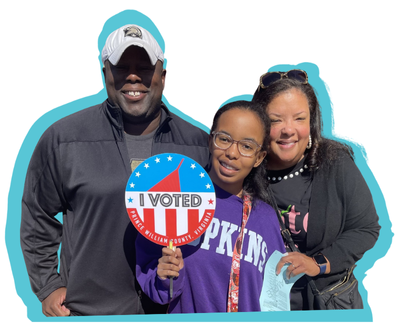
When Missy’s daughter was just eight years old, she was diagnosed with brain cancer. This already difficult moment was made even harder by the fact that Missy, a career educator, didn’t qualify for paid leave. In a time when bills and fear were mounting, Missy was faced with the impossible choice of keeping her job or caring for her daughter. Missy is one of thousands of Virginian caregivers forced to make choices between a paycheck and being present for life’s most critical moments. Virginians will face a different set of choices in the future, thanks to the gradual implementation of paid leave policies (see implementation timelines below for more details).
The United States is the only industrialized nation in the world without a national paid family leave program. In Virginia, about 3.5 million workers (76% of the workforce) do not have access to paid family and medical leave. This means more than three in every four workers in Virginia lack access. Each year, an estimated 339,000 workers miss out on taking the time they need simply because they can’t afford to.
PFML can be used for the many instances when workers may need weeks or months to care for themselves or a loved one. PFML can be used for a range of situations, including bonding with a newborn or adopted child, supporting a loved one through end-of-life care, recovering from a serious illness like cancer, or finding safety after domestic violence.
1.2 million private sector workers in Virginia (41% of the workforce) do not have a single paid sick day. Workers can use paid sick leave when recovering from a short-term illness like the flu, caring for a family member, such as picking up a child from the nurse’s office, or going to a preventative appointment, like the dentist. Notably, the majority of workers without paid sick days are low-wage workers and people of color.
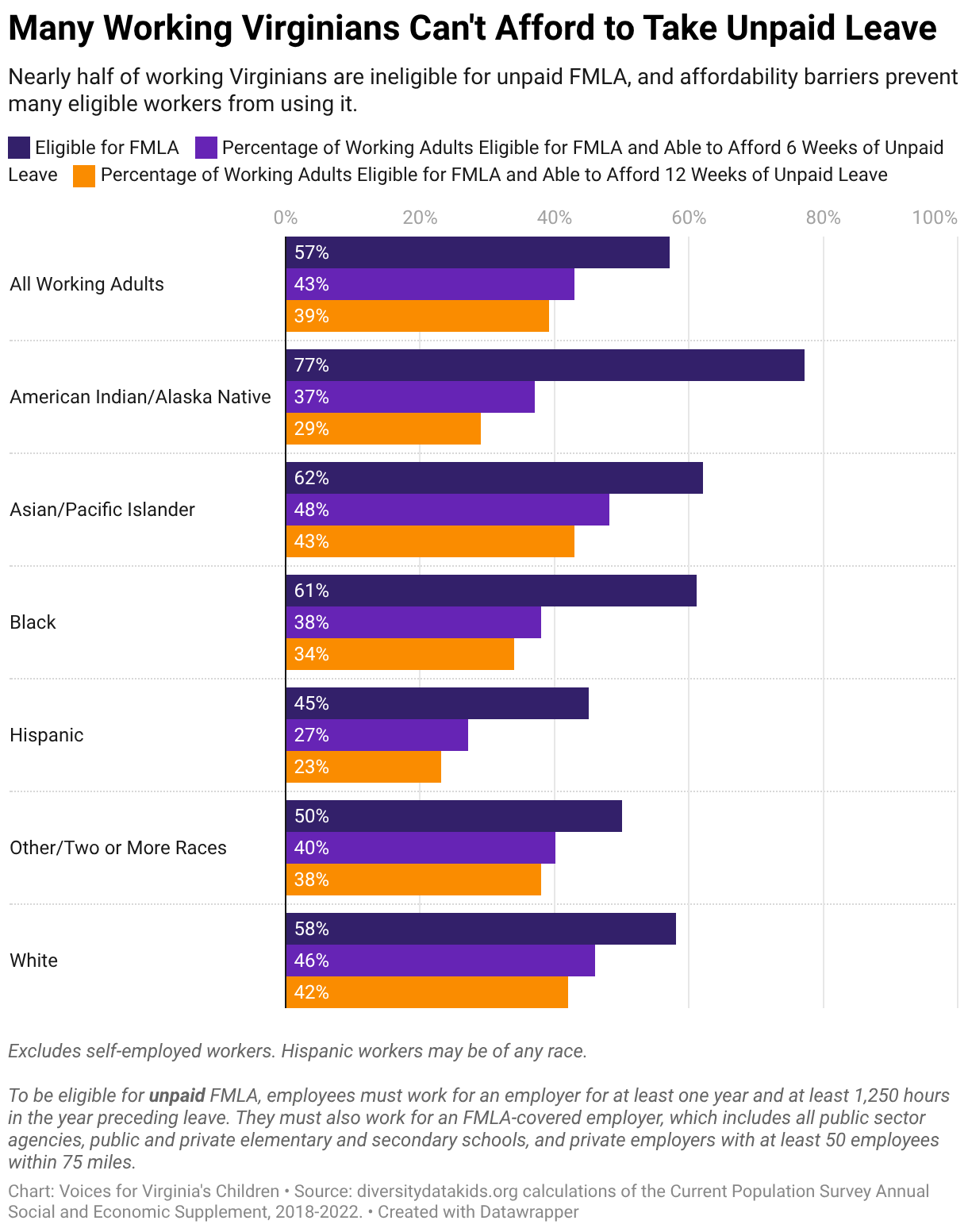
Roughly half of Virginia’s workers have access to unpaid Family and Medical Leave Assistance (FMLA). However, since the leave is unpaid, not everyone can afford to use it. The graph below demonstrates the racial and ethnic disparities in who can afford to take such leave, with those identifying as Black, Hispanic, and American Indian/Alaska Natives having the least ability to take unpaid time off.
The lack of paid leave also disproportionately impacts women, who are more likely to take on additional caretaking labor and/or leave the labor force due to caretaking responsibilities. In Virginia, women are also often the primary breadwinners, with 73% of Black mothers, 45% of Latina mothers and 46% of white mothers’ wages primarily supporting their households. These realities can have devastating consequences for a family’s ability to care for their children and maintain financial stability.
In 2026, Virginia legislators passed PFML and PSD policies. The governor has expressed her support, and if not vetoed, Virginians will soon have the opportunity to take time to care for themselves and loved ones in the future. This progress comes after years of collective advocacy, with champions like Senator Boysko, who has partnered with Voices to advance PFML since 2019, helping to move the work forward. The journey toward full implementation of these policies will continue over the next few years.
Once implemented, nearly one in three workers nationally will have access to a state paid leave program, according to The National Partnership for Women and Families.
These policies will be phased in over several years. Here’s what to expect:
(Timeline based on bill language)
Governor Spanberger’s deadline to sign, amend, or veto the legislation.
A special session begins to finalize the state’s two-year budget, which should include funding for a treasury loan to help launch the program. (See 359 #1s and 359 #3h)
Contribution rates for employers and employees set (typically 0.5% each).
The Virginia Employment Commission finalizes rules and regulations. Payroll contributions to the PFML insurance program fund begin.
Eligible workers can begin applying for and receiving PFML benefits.
A PFML participation dashboard is established.
These policies will be phased in based on employer size. Here’s what to expect:
(Based on bill language)
Governor Spanberger’s deadline to sign, amend, or veto the legislation.
Lawmakers begin a special session to finalize the state budget. The two-year budget is expected to include funding to support implementation of paid sick days. (See budget amendments 352 #1s, 352 #1h, 352 #3h, and 471 #1h)
The Department of Human Resource Management will report to the governor and the Chairs of the House Appropriations and Senate Finance and Appropriations Committees on the impacts to human resources policies, systems, and associated costs.
Policy takes effect for employers of at least 50 employees.
Policy takes effect for employers with at least 25 employees.
Department of Labor and Industry (DOLI) receives funding to hire 14 additional staff to support implementation, enforcement, and complaint tracking.
Policy takes effect for all employers.
Both paid leave policies will support the mental and physical wellbeing of workers and their families. Workers without paid sick days experience greater symptoms of distress compared to those with access . When people can stay home while sick or caring for a loved one, it improves public health and helps keep communities healthier.
Paid family medical leave will support families, especially those welcoming a new child. National studies on PFML show improvements in maternal and infant health, as well as increased involvement from fathers. A benefit-cost analysis from Vanderbilt’s Prenatal-to-3 Policy Center found that the benefits of bonding leave alone outweigh the costs 8.4 to 1, generating an estimated $224 million in net benefits annually for Virginia’s families, businesses, and the state. There are also additional benefits for children whose families receive such leave.
Workers and businesses will both benefit from paid sick policies. These policies help prevent Virginians from falling into the health-poverty-trap . They will save workers an estimated $1.4 billion each year in lost wages from unpaid or partially paid leave. Paid time to care also supports small businesses by reducing turnover, improving morale, and allowing them to compete with larger corporations . Nationally, 79% of small businesses support a paid family and medical leave program.
While the lack of paid leave has disproportionately harmed low-income workers, people of color, and women, its impact has been felt across all communities. With the passage of PFML and PSD, Virginia has taken a meaningful step forward, ensuring more people have the time and support they need to care for themselves and their loved ones. This progress reflects what’s possible when policy is shaped by real stories, real needs, and a shared commitment to supporting families across the commonwealth.
This progress reflects what’s possible when policy is shaped by real stories, real needs, and a shared commitment to supporting families across the commonwealth.

June 2, 2026

January 30, 2026
January 8, 2026
June 2, 2026
January 30, 2026
January 8, 2026